

Most people who go to Kedarnath come back different.
Not dramatically. Not in ways they can always explain. But they pause more before speaking. They sit with things longer. They breathe differently.
The history of Kedarnath is part of why that happens. This is not just a temple at the top of a mountain. It is a place that has been carrying the weight of human longing — for forgiveness, for meaning, for something larger than ordinary life — for more than a thousand years. Perhaps much longer.
This guide tells that story completely. The mythology, the architecture, the floods, the reconstruction, the rituals, and what it takes to stand in front of the Shivling in 2026. Whether you are planning your first visit or your fifth, understanding Kedarnath’s history changes how you experience it.
Kedarnath at a Glance – Key Facts
| Detail | Information |
| Location | Rudraprayag district, Uttarakhand |
| Altitude | 3,583 metres (11,755 feet) |
| River | On the banks of the Mandakini |
| Deity | Lord Shiva (as the hump of a bull) |
| Classification | One of the 12 Jyotirlingas; part of Char Dham and Panch Kedar |
| Temple constructed | Estimated 8th century CE (rebuilt by Adi Shankaracharya) |
| Open season 2026 | May to October 2026 |
| Nearest base camp | Gaurikund (14 km trek to temple) |
| Nearest helipad | Phata, Guptkashi, Sirsi |
| Winter seat | Omkareshwar Temple, Ukhimath |
The Mythological History of Kedarnath – Why the Pandavas Came Here
Every explanation of Kedarnath history begins with the Pandavas, and for good reason. The mythology is not just an old story — it is a moral framework that still shapes how millions of pilgrims understand this place.
After the Kurukshetra War, the Pandavas had won. But winning felt hollow. They had killed their own kin. Guru Dronacharya, Bhishma Pitamah, and countless cousins lay dead on the battlefield. The victory was real; the guilt was also real.
The Pandavas sought out Lord Shiva to confess their sins and seek his blessings. But Shiva was reluctant. He did not wish to absolve those who had caused such destruction. He took the form of a Nandi (bull) and disappeared into the Garhwal Himalayas to avoid them.
Bhima, the strongest of the Pandavas, spotted the bull near Guptakashi. He tried to stop it, but the bull dived into the ground. Bhima managed to grab its tail and hind parts. Shiva’s body was said to have then appeared in five different locations across the Himalayas — the Panch Kedar (five Kedars).
At Kedarnath, the hump (Kunda) of the bull emerged. This is why the Shivling at Kedarnath is shaped like a triangular hump — it does not look like a conventional Shivling. It is uniquely raw, almost rough, as if carved by the mountain itself.
The Pandavas built the original temple at Kedarnath in gratitude and penance. They then proceeded to heaven via the Swargarohini range. This is the origin story that devotees carry with them on the trek.
Kedarnath as One of the 12 Jyotirlingas
The Kedarnath Jyotirlinga is one of the twelve Jyotirlingas — the twelve sacred abodes where Lord Shiva is believed to have manifested as a column of light (Jyoti), beyond form and beyond measure.
The twelve Jyotirlingas are scattered across India, from Somnath in Gujarat to Rameshwaram in Tamil Nadu. But Kedarnath is considered among the most powerful — and the most difficult to reach — which many devotees believe makes the blessing proportionately greater.
The verse from the Shiva Purana that lists the Jyotirlingas places Kedarnath alongside Mahakaleswar (Ujjain), Omkareshwar (Madhya Pradesh), Kashi Vishwanath (Varanasi), and others. For a devotee who has visited all twelve, Kedarnath is often described as the one that never leaves you.
The Historical Timeline of Kedarnath Temple
The Original Temple (Pre-8th Century)
The exact date of the original Kedarnath temple’s construction is unknown. Hindu texts — including the Skanda Purana and Shiva Purana — mention Kedarkshetra as a sacred tirtha, suggesting the site was revered long before any formal structure was built.
Scholars believe a simple shrine existed on the site for many centuries, tended by local priests and visited by pilgrims who undertook the mountain journey on foot.
Adi Shankaracharya and the Reconstruction (8th Century CE)
The major turning point in Kedarnath temple history is the visit of Adi Shankaracharya, the 8th-century philosopher-saint who travelled across India reviving Hindu philosophy and establishing the four sacred mathas (monasteries).
Adi Shankaracharya is credited with rebuilding and reinvigorating the Kedarnath temple around the 8th century CE. He also established the Jyotirmath (Joshimath) as one of his four mathas, which oversees Badrinath. His presence in this region marked the formal integration of Kedarnath into the mainstream of Hindu pilgrimage.
Adi Shankaracharya is believed to have attained mahasamadhi (conscious death) at Kedarnath at the age of 32. A samadhi (memorial) behind the temple marks this spot and is visited by pilgrims as a sacred site in itself.
The Temple Through Medieval History
Records from the medieval period confirm that Kedarnath remained an active pilgrimage centre through the centuries, supported by rulers of the Garhwal Kingdom who maintained and protected the temple. The temple’s management was handled by the Rawal (chief priest), traditionally from the Veerashaiva community of Karnataka — a tradition that continues to this day.
The Temple Committees and Modern Administration
In the modern era, Kedarnath is administered by the Shri Badrinath-Kedarnath Temple Committee (BKTC), established under the Uttarakhand government. The BKTC manages the opening and closing of the temple (Kapat Khulna and Kapat Band), the appointment of priests, and the upkeep of the shrine.
Kedarnath Temple Architecture – Built to Outlast Time
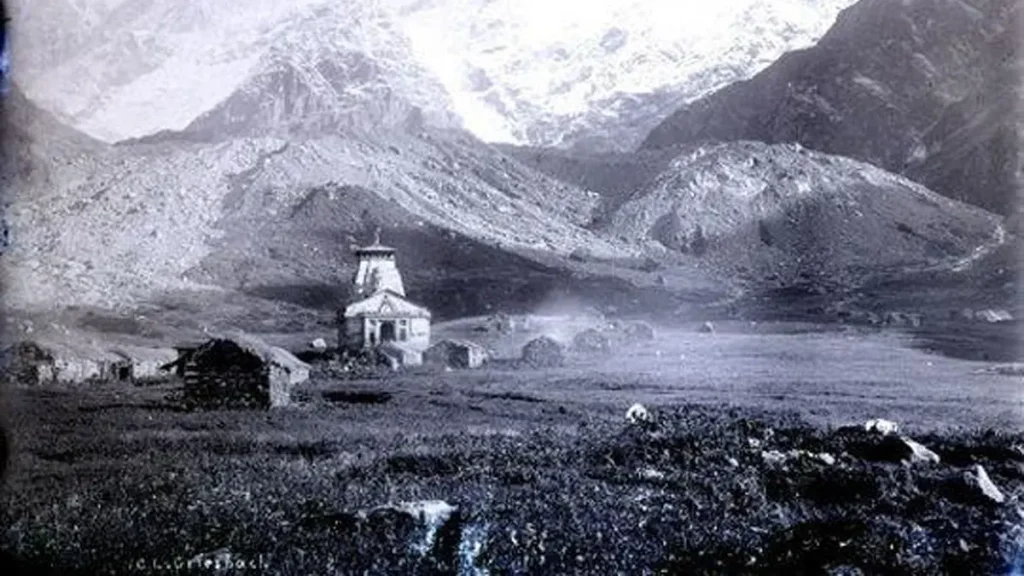
One of the most remarkable facts in Kedarnath history is the temple’s architecture. Built with massive, interlocking grey granite stones without mortar or cement, the structure has withstood centuries of Himalayan snowfall, earthquakes, and the catastrophic floods of 2013.
Key architectural features:
The temple is rectangular, approximately 3.6 metres by 6 metres at the base, with walls that are 2.1 metres thick. The stone blocks are fitted together using a precise tongue-and-groove system — each block cut to lock into the next, creating a structure that absorbs force rather than resisting it.
The Garbhagriha (sanctum) houses the unusual triangular Shivling — the form of Shiva’s back that emerged from the earth. The Mandapa (hall) in front has intricately carved pillars featuring deities, celestial beings, and floral motifs. Above the sanctum rises a conical shikhara (spire) topped with a golden kalash.
The entire structure sits on a raised platform accessible by a short flight of stone steps. The entrance gate faces east, greeting the morning sun.
What strikes most visitors is not the scale but the solidity. The walls feel ancient in the truest sense — not worn down, but worn into the landscape. The temple does not look like it was placed there. It looks like it grew there.
The 2013 Kedarnath Floods – A Defining Moment in Modern History
No account of Kedarnath’s history can avoid June 2013.
On 16–17 June 2013, the Chorabari glacier lake burst its banks following exceptionally heavy monsoon rainfall. The resulting floods and landslides devastated the Kedarnath valley. The town of Kedarnath was largely destroyed. Thousands of pilgrims and locals lost their lives. Entire villages along the Mandakini River were swept away.
The scale of destruction was described as the worst natural disaster in Uttarakhand’s modern history.
And yet — the temple stood.
A massive boulder, later called the Bhim Shila, was swept by the floodwaters from behind the temple and came to rest precisely between the hillside and the temple’s rear wall. It took the full force of the debris flow, protecting the Garbhagriha from direct impact. The temple’s stone walls, built without mortar more than a thousand years earlier, held.
When rescue teams arrived, they found the Shivling intact. The lamp inside had not gone out.
People still lower their voices when they talk about this. Whether one calls it divine protection or extraordinary coincidence, the fact remains: everything around the temple was destroyed, and the temple was not.
The Bhim Shila now sits permanently behind the temple and has itself become a place of reverence.
Kedarnath After 2013 – Reconstruction and Revival
The years following 2013 saw a massive reconstruction effort led by the Uttarakhand state government, the Indian Army, NDRF (National Disaster Response Force), and private organisations.
Key developments since 2013:
A retaining wall and controlled drainage channels were built behind the temple to manage future glacier meltwater. The path from Gaurikund to Kedarnath was rebuilt and widened. New resting stops, food stalls, and medical posts were set up along the route. Helicopter services were expanded significantly, with multiple helipads at Phata, Guptkashi, and Sirsi.
By 2017, Kedarnath was receiving record numbers of pilgrims again. By 2022, a new statue of Adi Shankaracharya was installed near his samadhi behind the temple, inaugurated by the Prime Minister — marking a significant moment in the shrine’s modern history.
Today, Kedarnath handles lakhs of pilgrims every season. Infrastructure continues to improve, though the trek and the altitude remain as humbling as ever.
Panch Kedar – Understanding Kedarnath’s Wider Sacred Context
Kedarnath is the most prominent of the Panch Kedar — the five Shiva temples in Uttarakhand that together mark the five places where the bull-form of Shiva appeared.
| Panch Kedar Temple | Body Part of the Bull | Location |
|---|---|---|
| Kedarnath | Hump (Kunda) | Rudraprayag district |
| Tungnath | Arms | Rudraprayag district |
| Rudranath | Face | Chamoli district |
| Madhyamaheshwar | Navel | Rudraprayag district |
| Kalpeshwar | Hair and head | Chamoli district |
Kedarnath is the largest, highest-profile, and most visited of the five. But dedicated pilgrims undertake the Panch Kedar Yatra — visiting all five temples in one season — as a complete pilgrimage in its own right.
How to Reach Kedarnath in 2026
By Trek (The Traditional Way)
The standard route to Kedarnath starts from Gaurikund (1,982 metres), the base camp. From Gaurikund, the trek is approximately 16–18 km (depending on the route taken) through forests, mountain meadows, and rocky terrain, with a gradual ascent to 3,583 metres.
Most fit pilgrims complete the trek in 5–7 hours. Horses, mules, and palki (palanquin) services are available for those who need them.
Intermediate stops at Jungle Chatti, Bheembali, Lincholi, and Rudra Point provide food, water, and rest.
By Helicopter – The Fastest and Most Comfortable Option
For senior pilgrims, families with young children, or anyone on a tight schedule, the helicopter service to Kedarnath has transformed access to this shrine over the last decade.
Multiple helicopter operators run services from Phata, Guptkashi, and Sirsi helipads to the Kedarnath helipad, with a flight time of around 7–10 minutes. Helicopter slots book out weeks in advance during peak season.
If you want to combine Kedarnath and Badrinath by helicopter without the physical demands of the full trek, our Do Dham Yatra by Helicopter is designed exactly for this. Covering both Jyotirlinga shrines in a seamlessly organised itinerary, it is the most popular choice for pilgrims who value darshan over difficulty, and for elderly devotees for whom the trek is not medically advisable.
For those who wish to experience all four sacred shrines — Yamunotri, Gangotri, Kedarnath, and Badrinath — in a single, unforgettable journey without road-travel risks, our Chardham Yatra by Helicopter offers a complete, guided pilgrimage covering the full Char Dham circuit by air. Kedarnath is the centrepiece of every itinerary.
Best Time to Visit Kedarnath in 2026
The Kedarnath temple opens in early May 2026 (on Akshaya Tritiya) and closes in late October 2026 (around Maha Dwadashi after Diwali).
| Month | Conditions | Recommended? |
|---|---|---|
| May | Opening crowds, clear weather, some snow on trail | ✅ Excellent |
| June | Warm, busy, risk of early monsoon rain | ✅ Good |
| July – August | Monsoon season, landslide risk on roads | ⚠️ Caution advised |
| September | Post-monsoon clarity, thinner crowds | ✅ Excellent |
| October | Cold but beautiful, closing season energy | ✅ Very good |
September and early October are widely considered the best months to visit — the skies are clearest, the Himalayan views are most spectacular, and the crowds are more manageable than June
What Happens at the Temple – The Darshan Experience
The temple opens before dawn. The most coveted ritual is the Abhishek puja — a private ceremony where priests perform ritual bathing of the Shivling with milk, water, ghee, and honey, followed by the application of camphor and sandalwood.
The Maha Abhishek is booked in advance and allows a small group of pilgrims to be present in the Garbhagriha during the ceremony — an experience that many describe as the most powerful moment of their lives.
General darshan involves joining the queue, entering the Garbhagriha, and touching the Shivling. Unlike most temples, the Shivling here is not separated behind glass or rope. You place your hand directly on the hump-shaped stone. Many people say something inside them changes in that moment.
The evening Aarti is equally moving — the entire temple lit with lamps, the sound of bells and Vedic chanting filling the cold mountain air while the valley below disappears into darkness.
Where Kedarnath’s Deity Goes in Winter
Each year after the closing ceremony, the Panchmukhi Doli — a sacred palanquin carrying the five-faced image of Lord Shiva — travels from Kedarnath to Omkareshwar Temple in Ukhimath, 41 km away. This journey, conducted in a grand procession, takes several days.
At Ukhimath, the deity is worshipped through the six winter months. The temple is accessible by road, and many pilgrims visit Ukhimath specifically to have darshan during the off-season. The rituals at Ukhimath follow the same traditions as at Kedarnath — same priests, same prayers, same devotion.
When spring arrives, the Doli returns to Kedarnath in another procession, accompanied by thousands of pilgrims who walk with it. The return journey — the Kapat Khulna procession — is one of the great spectacles of the Himalayan pilgrimage calendar.
Why Kedarnath History Continues to Be Written
Every year, another several lakh people experience Kedarnath for the first time. Another generation of pilgrims makes the trek, touches the stone, and comes back slightly changed.
The history of Kedarnath is not something that ended centuries ago. It is being added to every season. Every person who sits on the stone steps and watches the sun rise over the Kedarnath peak is part of it.
That is what makes it unusual. Most ancient sites are visited to look at the past. Kedarnath asks you to add to it.
Kedarnath Yatra 2026 – Plan Your Visit
Kedarnath is part of both the Char Dham Yatra and the Do Dham Yatra circuits. Planning your visit well in advance is essential for 2026, as accommodation, helicopter slots, and registration all fill up quickly.
If you want to visit only Kedarnath and Badrinath: Our Do Dham Yatra by Helicopter covers both shrines with full accommodation, transfers, and guided darshan assistance — ideal for pilgrims who want a focused, spiritually immersive experience at the two most sacred Shiva and Vishnu temples in the Himalayas.
If you want the complete Char Dham experience — all four shrines by air: Our Chardham Yatra by Helicopter is India’s most comprehensive aerial pilgrimage, covering Yamunotri, Gangotri, Kedarnath, and Badrinath in one seamless journey. Every detail is taken care of so you can focus entirely on the darshan.
Both packages are designed to accommodate senior pilgrims, families, and devotees who value safety, comfort, and a spiritually unhurried experience.