

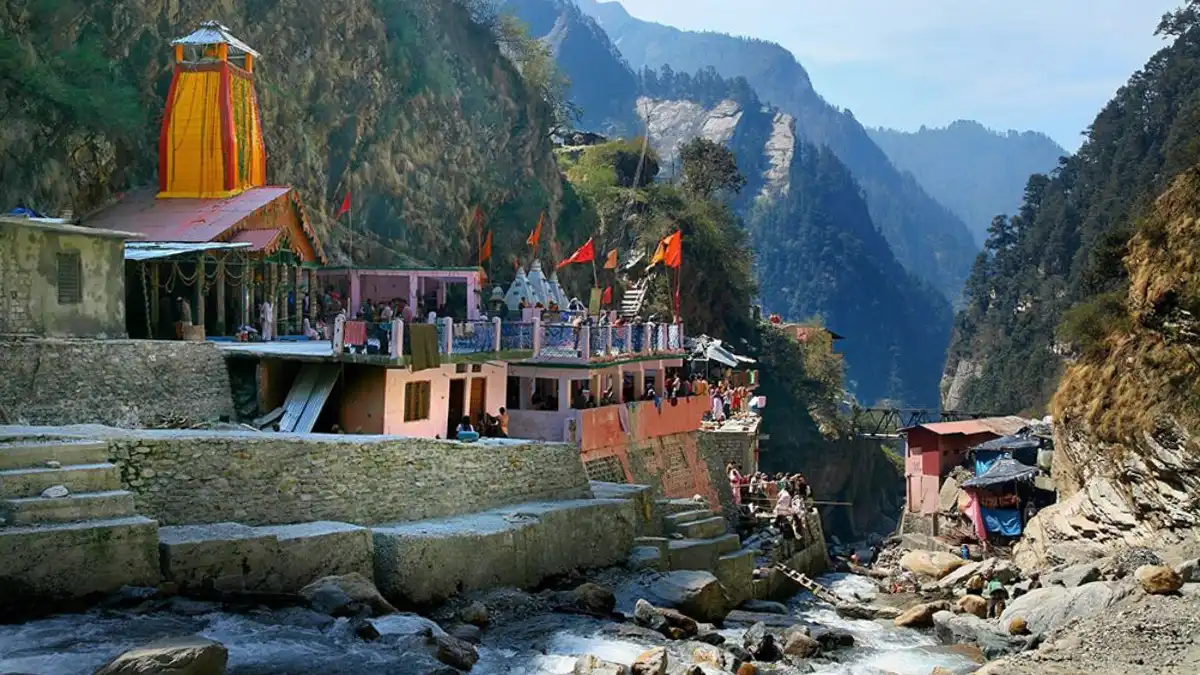
Yamunotri Temple History — The Sacred Origin of Mother Yamuna
High in the western Garhwal Himalayas, tucked into a narrow valley at 3,291 metres (10,804 feet) above sea level, stands one of India’s most revered mountain shrines — Yamunotri Temple. This is where the sacred Yamuna River is believed to have descended from the heavens, where ancient sages once meditated, and where millions of pilgrims begin the holiest circuit in Hinduism — the Chardham Yatra.
The history of Yamunotri Temple is not written in a single chapter. It is a layered story — of mythological birth, of royal patronage, of destruction and reconstruction, of living rituals unchanged across centuries, and of a community of priests who have kept this flame alive through every season. To understand Yamunotri is to understand why rivers in India are never merely rivers — they are mothers, they are deities, they are the lifeblood of civilization.
Whether you are a devout pilgrim seeking darshan, a history enthusiast drawn to ancient legends, or a traveller planning your 2026 Chardham Yatra, this complete guide to Yamunotri Temple history, significance, rituals, and practical visitor information will prepare you for one of the most meaningful journeys of your life.
Quick Facts: Yamunotri Temple at a Glance
| Detail | Information |
|---|---|
| Full Name | Yamunotri Dham |
| Deity | Goddess Yamuna (Daughter of Surya) |
| Location | Uttarkashi District, Uttarakhand |
| Altitude | 3,291 metres (10,804 feet) |
| Trek Base | Janki Chatti (6 km trek to temple) |
| Position in Chardham | First Dham (starting point of circuit) |
| 2026 Opening Date | 30 April 2026 (Akshaya Tritiya) — Tentative |
| 2026 Closing Date | November 2026 (Diwali, Yam Dwitiya) — Tentative |
| Winter Seat (idol) | Kharsali Village |
| Priests | Panda community from Kharsali |
| Famous Features | Surya Kund, Divya Shila, Gauri Kund |
| Best Time to Visit | May–June, September–October |
Mythological Origins of Yamunotri Temple — Who Is Goddess Yamuna?
The history of Yamunotri Temple begins long before any stone was laid — it begins in the cosmos.
Yamuna: Daughter of the Sun God
Hindu scripture holds that Goddess Yamuna is the daughter of Surya (the Sun God) and Saranyu, making her the twin sister of Yama — the God of Death and Dharma. This divine lineage gives Yamuna a unique power: because she is Yama’s sister, those who bathe in her sacred waters are believed to be granted protection from untimely death and the fear of Yama’s judgment. The Padma Purana states that bathing in the Yamuna on specific auspicious days washes away all sins across seven lifetimes.
This is not merely mythology — it is the living faith that has driven pilgrims up these rocky mountain paths for thousands of years.
The Legend of Sage Asita Muni
One of the most beloved stories in Yamunotri temple history involves the ancient sage Asita Muni, who spent his entire life in deep meditation on these slopes. In his old age, too frail to undertake the long journey to bathe in the Yamuna at Mathura, Asita Muni is said to have prayed with such devotion that the river herself came to him — flowing to this mountain valley so that her greatest devotee could receive her blessings without journeying downstream. The site where this miracle occurred is held to be the sacred ground on which the temple now stands.
Yamunotri and the Mahabharata
Another strand of Yamunotri’s history weaves through the Mahabharata. The Pandavas — after the great war of Kurukshetra — are said to have visited Yamunotri as part of their penance and pilgrimage through the Himalayas. This connection to the Pandavas, who also figure prominently in the legends of Kedarnath and Badrinath, deepens Yamunotri’s significance within the broader sacred geography of Uttarakhand.
Yamunotri and the Ramayana
Some local traditions also associate Yamunotri’s history with the Ramayana. According to these accounts, Hanuman — while searching for the Sanjeevani herb to revive Lakshmana — passed through this valley, leaving a spiritual imprint that locals honour to this day.
The True Source of the Yamuna — Yamunotri Glacier
A distinction that visitors often miss: the Yamunotri Temple is not located at the actual source of the Yamuna River. The true glacial origin of the Yamuna lies at Champasar Glacier on the slopes of Bandarpunch Peak (6,316 m), about 2 kilometres above the temple. This glacier is accessible only to seasoned trekkers and mountaineers due to its extreme altitude and terrain.
The temple was established at the point where the river becomes accessible to ordinary pilgrims — and where the sacred Surya Kund hot spring emerges. This practical decision, made centuries ago, transformed a glacial stream into a living pilgrimage destination that millions can visit without professional mountaineering skills.
Who Built Yamunotri Temple? — The Real History of Construction
The structural history of Yamunotri Temple is one of repeated cycles of destruction and rebuilding — a pattern common to Himalayan shrines that face earthquakes, avalanches, floods, and the unrelenting force of mountain winters.
The 19th-Century Rebuild by the Jaipur Royal Family
The temple that pilgrims visit today traces its modern origins to the 19th century. Maharani Gularia of Jaipur — wife of Maharaja Man Singh of Jaipur — is widely credited with sponsoring the construction of a formal temple structure at Yamunotri. This act of royal patronage transformed what was primarily a pilgrimage site around natural features (the hot springs and the sacred Divya Shila rock) into a proper temple complex with a sanctum sanctorum housing the idol of Goddess Yamuna.
Reconstruction by the Tehri-Garhwal Royal Family
Following the devastating earthquake of 1803 and subsequent damage from floods and landslides over the decades, Maharaja Pratap Shah of Tehri Garhwal undertook the significant task of rebuilding and restoring the temple. The Tehri royal family maintained strong patronage of Yamunotri and is closely associated with the temple’s modern form.
This cycle of damage and rebuilding is not seen as a failing in Yamunotri’s history but as a testament to the enduring faith of the people — royals and common pilgrims alike — who have refused to let the shrine disappear.
Architectural Style
The temple follows a modest North Indian Nagara-style architecture, adapted for the Himalayan environment:
- Materials: Local stone and timber, chosen for thermal insulation against the mountain cold
- Roof: Small, cone-shaped shikhara (temple spire) topped with religious flags
- Sanctum: A compact inner shrine housing the black marble idol of Goddess Yamuna seated on a tortoise, with a silver idol of Ganga beside her
- Orientation: Faces the sacred Surya Kund hot spring, reinforcing the ritual connection between the goddess and the sun’s energy manifest in the earth
The temple’s compact, robust design reflects the wisdom of mountain builders who understood that survival against the elements matters more than grandeur. Unlike the elaborate carvings of plains temples, Yamunotri’s beauty is in its setting — the stark, white-capped peaks behind, the rushing river below, and the fragrant marigolds offered by pilgrims that carpet the stone courtyard.
Divya Shila — The Sacred Rock at the Heart of Yamunotri
Among all the elements of Yamunotri Temple history, perhaps none is more spiritually charged than the Divya Shila — a tall, naturally occurring rock pillar that stands beside the entrance to the main shrine.
What Is Divya Shila?
“Divya Shila” means divine stone or celestial rock. Hindu tradition holds that this rock is imbued with the energy of the goddess herself. Before any pilgrim enters the main temple to take darshan of Goddess Yamuna, they must first worship the Divya Shila — offering flowers, water, and prayers to the sacred rock.
This ritual is not optional. It is considered the proper and respectful way to approach Yamunotri. The Divya Shila serves as a threshold between the ordinary world and the sanctified space of the goddess — a moment of preparation and reverence.
Why Is Divya Shila Worshipped First?
The tradition mirrors the principle found across Hindu temples that the divine space must be approached gradually — through a progression of sacred elements — rather than entered abruptly. Worshipping Divya Shila is the pilgrim’s act of announcing their arrival and intention to the goddess, seeking her permission before entering her abode.
Surya Kund — The Miracle of the Boiling Hot Spring
Immediately in front of Yamunotri Temple is the Surya Kund — a natural geothermal hot spring that is one of the most extraordinary natural phenomena at any Indian pilgrimage site.
The water in Surya Kund reaches a temperature of nearly 90°C (194°F), close to boiling point. This remarkable heat is attributed, in Yamunotri temple tradition, to the blessing of Surya Dev (the Sun God), Yamuna’s divine father — his warmth made manifest in the earth near his daughter’s abode.
The Prasad Ritual — Cooking in Sacred Waters
The hot spring is not merely an object of wonder — it plays an active, practical role in the pilgrimage ritual that is unique to Yamunotri among all the Chardham destinations:
Pilgrims bring raw rice or potatoes from home, place them in a small cloth or wire mesh bag, and cook them in the waters of Surya Kund. The food that emerges — known as Charnaymrit Prasad — is then offered to the goddess and later consumed by the family as a divine blessing. The idea is profound: the sacred energy of Surya Kund infuses ordinary food with the goddess’s grace, transforming a humble grain or vegetable into something spiritually nourishing.
This cooking ritual is one of the most memorable aspects of any Yamunotri pilgrimage and something pilgrims look forward to as much as the darshan itself.
Gauri Kund — The Bathing Spring
Adjacent to Surya Kund is the cooler Gauri Kund, named for Goddess Parvati (Gauri). While Surya Kund is too hot for bathing, Gauri Kund’s more moderate temperature makes it suitable for ritual bathing before darshan. Pilgrims who wish to purify themselves before entering the temple traditionally bathe here, continuing a practice described in Yamunotri’s historical texts.
Daily Rituals and Seasonal Traditions at Yamunotri Temple
Daily Puja Schedule
The priests of Yamunotri — drawn from the Pandit community of Kharsali village — perform a structured daily ritual cycle:
| Time | Ritual |
|---|---|
| Early Morning (before dawn) | Mangala Aarti — awakening the goddess |
| Morning | Shringar (adornment of the idol with fresh garments and flowers) |
| Afternoon | Bhog Offering — food offerings to the goddess |
| Evening | Sandhya Aarti — the most popular aarti, attended by all pilgrims |
| Night | Shayan Aarti — the goddess is put to rest |
The evening Sandhya Aarti is the highlight of any visit to Yamunotri. As the mountain air cools rapidly after sunset, the sound of bells, the sight of camphor flames, and the chanting of priests create an atmosphere that pilgrims consistently describe as transformative.
The Seasonal Migration of the Idol — A Living Tradition
One of the most distinctive aspects of Yamunotri Temple history is its annual seasonal cycle. Because the temple sits at a high altitude where winter brings heavy snowfall (often several metres), making the path completely inaccessible from November onwards, the sacred idol of Goddess Yamuna is moved each year:
Opening (Akshaya Tritiya): Each spring, on the auspicious occasion of Akshaya Tritiya (which falls in April–May), a grand procession carries the idol from its winter home in Kharsali village back up the mountain to the temple. The procession is accompanied by traditional music, flowers, and the gathering of hundreds of devotees. In 2026, Yamunotri Temple is tentatively set to open on 30 April (Akshaya Tritiya).
Closing (Yam Dwitiya / Bhai Dooj): In late October or early November, after Diwali, on the occasion of Yam Dwitiya (the day dedicated to the bond between Yama and Yamuna), the idol is ceremonially moved back down to Kharsali for the winter months. The temple doors are then closed until the following Akshaya Tritiya.
This annual opening and closing is not merely logistical — it is theologically significant. The goddess is seen as dwelling in the valley in summer and retreating to a warmer, lower home in winter, mirroring the seasonal rhythms of the Himalayan world.
Akshaya Tritiya — The Auspicious Opening Day
In Hindu belief, Akshaya Tritiya is one of the most auspicious days of the year — a day when any new beginning is blessed with unending abundance. The choice of this day to open the Chardham temples each year is deeply intentional: pilgrims who begin their Chardham Yatra on or near Akshaya Tritiya believe their merit is multiplied many times over.
Sacred Sites Near Yamunotri Temple — Complete 2026 Guide
A visit to Yamunotri is not limited to the main shrine. The valley holds several other spiritually and naturally significant spots:
1. Surya Kund & Gauri Kund
The twin hot springs at the heart of the pilgrimage experience. Surya Kund for the prasad-cooking ritual; Gauri Kund for ritual bathing. These are steps from the temple entrance.
2. Divya Shila
The sacred rock pillar worshipped before entering the main shrine — the spiritual gateway of Yamunotri.
3. Yamuna’s True Source — Champasar Glacier (Bandarpunch)
The actual glacial origin of the Yamuna at approximately 4,421 metres, about 2 km above the temple. Accessible only to experienced trekkers with proper equipment and permits. Most pilgrims do not attempt this.
4. Janki Chatti
The main base village (2,650 m) where the 6-km trek to Yamunotri begins. Named after Sita (Janaki), this village has guesthouses, basic eateries, and pony/palanquin rental points. Shared jeeps from Barkot reach Janki Chatti.
5. Hanuman Chatti
Another base village slightly lower than Janki Chatti, at the confluence of the Hanuman Ganga and Yamuna rivers. Some pilgrims prefer to start their trek from here (longer route but more scenic). It connects mythologically to Hanuman’s presence in the region.
6. Kharsali Village
The winter home of the Yamunotri idol and the home of the temple’s priestly families. The village itself has a small Shani temple and offers an authentic glimpse into the daily life of Garhwali mountain communities. Worth visiting if you can arrange a day trip.
7. Saptarshi Kund
A high-altitude glacial lake (approximately 4,421 m) near the Bandarpunch glacier, associated in legend with the seven sacred sages (Saptarishis). A multi-day trek for serious mountaineers.
How to Reach Yamunotri Temple in 2026
By Air
The nearest airport is Jolly Grant Airport, Dehradun (~170 km from Janki Chatti). From Dehradun, take a shared or private taxi to Barkot or Janki Chatti via Mussoorie and Barkot. Journey time: approximately 6–8 hours depending on road conditions.
By Train
The nearest railheads are Rishikesh (~210 km) or Dehradun (~170 km). From either station, hire a taxi or take shared transportation to Janki Chatti via Barkot.
By Road
- Delhi to Janki Chatti: ~510 km via Haridwar–Rishikesh–Barkot. Journey time: 12–14 hours
- Haridwar to Janki Chatti: ~220 km via Rishikesh and Barkot. Journey time: 7–9 hours
- Rishikesh to Janki Chatti: ~195 km. Journey time: 6–8 hours
State buses (GMOU) operate from Haridwar and Rishikesh to Barkot and sometimes to Janki Chatti. Private taxis offer door-to-door convenience.
The Trek to Yamunotri
From Janki Chatti, the trek to Yamunotri Temple is 6 km (one way), gaining approximately 700 metres of altitude. The trail winds through pine forests, along the Yamuna River gorge, past waterfalls, and through small mountain settlements.
- Difficulty: Moderate
- Time: 2–3 hours up, 1.5–2 hours down
- Altitude at temple: 3,291 m
- Ponies and Palanquins: Available for hire at Janki Chatti — recommended for elderly pilgrims, children, and those with health concerns
Yamunotri and the Chardham Yatra — Its Special Role as First Dham
In the sacred Chardham Yatra — the pilgrimage to four divine shrines (Yamunotri, Gangotri, Kedarnath, and Badrinath) — Yamunotri is always the first stop. This is not arbitrary. The traditional west-to-east direction of the circuit is rooted in the flow of the rivers themselves, with Yamunotri in the far west and Badrinath in the east.
Starting at Yamunotri is spiritually significant: the pilgrim begins by invoking the Yamuna, seeking her grace to purify them before they proceed through the higher shrines. The prasad cooked in Surya Kund is often carried by pilgrims to offer at subsequent dhams — a thread of continuity that ties the entire circuit together.
Completing all four dhams in a single pilgrimage is believed to grant moksha (liberation from the cycle of rebirth) — the highest goal of Hindu spiritual practice.
Chardham Yatra by Helicopter — Visit Yamunotri Without the Trek
For pilgrims who want to cover all four dhams but find the trekking or road travel challenging — due to age, health, or time constraints — LIH Travel offers the Chardham Yatra by Helicopter package, which whisks you by air to all four sacred shrines, including Yamunotri, in just 5–6 days from Dehradun. This is the most comfortable and time-efficient way to complete the Chardham circuit in 2026, with VIP darshan, luxury stays, and Satvik meals included throughout.
The helicopter route means:
- No 6-km trek to Yamunotri
- No long road journeys through mountain hairpin bends
- VIP darshan access at each dham — less waiting, more prayer time
- Ideal for senior citizens, families with young children, and busy professionals
Focusing on Kedarnath and Badrinath? Try Do Dham by Helicopter
If your pilgrimage goal for 2026 focuses on Kedarnath and Badrinath (the two Shiva and Vishnu shrines that attract the largest number of pilgrims), LIH also offers the Do Dham Yatra by Helicopter — covering both dhams in as little as one day or in a relaxed 3-night/4-day format, with prices starting at ₹1,35,000 per person (all-inclusive).
Best Time to Visit Yamunotri Temple in 2026
| Season | Months | Conditions | Recommended? |
|---|---|---|---|
| Early Summer | Late April–May | Temple opens; pleasant days, cold nights | ✅ Excellent |
| Peak Summer | May–June | Clear skies, busy but manageable | ✅ Best Overall |
| Monsoon | July–August | Heavy rain, landslide risk, difficult trails | ⚠️ Avoid if possible |
| Post-Monsoon | Mid-Sept–October | Fresh greenery, clear skies, fewer crowds | ✅ Excellent |
| Winter | Nov–April | Temple closed; extreme snowfall | ❌ Temple inaccessible |
The sweet spots are May–June and mid-September to October. May is particularly popular because:
- Temperatures are pleasant (10°C to 20°C at the temple)
- The Akshaya Tritiya opening creates a festive atmosphere
- Mountain wildflowers are in bloom along the trek route
- Clear skies offer stunning views of Bandarpunch Peak
What to Carry — Yamunotri Pilgrimage Packing List 2026
Essentials
- Government Photo ID (Aadhaar / Passport) — mandatory for Uttarakhand Yatra registration
- Tourist Care Uttarakhand Yatra e-Pass — register free at registrationandtouristcare.uk.gov.in
- Sturdy trekking shoes with good ankle support and grip
- Warm layers — thermals, fleece jacket, windproof outer layer; temperature drops sharply in evenings
- Rainproof jacket or small poncho (essential during monsoon; useful other seasons too)
For the Ritual
- Raw rice or small potatoes in a small cotton or mesh bag — for cooking in Surya Kund as prasad
- Flowers (marigold/rose) and incense sticks for offering at Divya Shila and the temple
- Small container to carry prasad or holy water back for family members
Health & Comfort
- Altitude sickness tablets (Diamox or equivalent) — consult your doctor before travel
- Personal medications — carry extra supply; pharmacies are minimal above Barkot
- ORS sachets and digestive tablets — common need during pilgrimages
- Sunscreen (SPF 50+) and UV-protective sunglasses — UV intensity is high at altitude
- Reusable water bottle — stay hydrated; dehydration worsens altitude effects
- Energy bars and dry fruits — for sustenance during the trek
Practical Items
- Small daypack (5–10 litres) — carry only essentials on the trek
- Walking stick or trekking pole — significantly reduces knee strain on steep descent
- Portable power bank — limited charging options along the route
- Cash (small denomination notes) — some vendors and pony operators don’t accept digital payments
- Plastic bags to keep documents and electronics dry during rain
Dress Code and Temple Etiquette at Yamunotri
- Dress modestly — cover shoulders and legs inside the temple premises
- Remove footwear before entering the temple sanctum
- Switch off mobile phones or keep them on silent inside the shrine
- No photography inside the sanctum sanctorum; check signage for restrictions in other areas
- Do not drop litter — the trek path and temple area are under strict cleanliness guidelines
- Worship Divya Shila first before approaching the main idol — this is tradition, not optional
- Do not touch the idol — only the presiding priests may do so
- Non-vegetarian food and alcohol are prohibited in the entire Yamunotri area
Yamunotri Temple — Significance in 2026 and Beyond
The history of Yamunotri Temple is ultimately a story about resilience — of a place that has been washed away, buried under snow, shaken by earthquakes, and rebuilt every single time, because the faith of the people who love it is stronger than any natural force.
For the nearly one million pilgrims who visit Yamunotri each year, this temple is far more than a historical monument or a tourist attraction. It is the living home of a divine mother whose waters have sustained the cities and civilizations of northern India for millennia. The Yamuna River — which flows 1,376 km from this glacial shrine to merge with the Ganga at Prayagraj — is inseparable from the culture, agriculture, and spiritual identity of the people of the Gangetic plains.
To visit Yamunotri is to go to the source — not just of a river, but of a living tradition of faith that has endured for thousands of years and shows no sign of diminishing.
Plan Your Yamunotri Pilgrimage with LIH — 2026 Options
LIH Travel has been running Chardham pilgrimage packages for over 18 years, with a special focus on making these sacred journeys accessible to every type of pilgrim.
Complete All Four Dhams — Chardham Yatra by Helicopter
If Yamunotri is your first of four sacred stops, our Chardham Yatra by Helicopter package covers the entire circuit — Yamunotri, Gangotri, Kedarnath, and Badrinath — in a luxury helicopter journey from Dehradun. VIP darshan at every dham, luxury mountain stays, all meals, and 24×7 support from our experienced team.
Best for: Pilgrims who want to complete the full Chardham circuit comfortably, without strenuous road travel or trekking.
Focus on Kedarnath & Badrinath — Do Dham Yatra by Helicopter
For pilgrims specifically focused on the Shiva shrine at Kedarnath and the Vishnu shrine at Badrinath, our Do Dham Yatra by Helicopter covers both sacred dhams, with packages starting at ₹1,35,000 per person (all-inclusive). Choose between a Same Day format or a relaxed 3-Night/4-Day itinerary.
Best for: Devotees of Lord Shiva and Lord Vishnu with limited time or budget who want a focused, comfortable pilgrimage to the two most visited Himalayan shrines.
Frequently Asked Questions — Yamunotri Temple History & Visit 2026
Yamunotri Temple is the northernmost dham in the Chardham circuit and the source shrine of the Yamuna River. Its history spans thousands of years of mythology and several centuries of physical construction, patronage by Jaipur and Tehri-Garhwal royal families, and continuous rebuilding after natural disasters. It is one of the holiest sites in Hinduism, associated with Goddess Yamuna (daughter of Surya) and her role as protector from Yama’s judgment.
The temple as it stands today was primarily built and patronized by Maharani Gularia of Jaipur in the 19th century and subsequently restored by Maharaja Pratap Shah of Tehri Garhwal after earthquake damage. The priests and ritual custodians are from the Panda/Purohit families of Kharsali village, who have maintained the temple’s traditions for generations.
Yamunotri Temple is tentatively scheduled to open on 30 April 2026 (Akshaya Tritiya) and close in November 2026 (Yam Dwitiya / Bhai Dooj, the day after Diwali). Confirm exact dates with local authorities closer to your travel date.
Divya Shila is a sacred rock pillar standing beside the entrance of Yamunotri Temple. Pilgrims must worship Divya Shila before entering the main shrine to take darshan of Goddess Yamuna. It is considered a divine threshold — the spiritual gateway to the goddess.
Surya Kund is a geothermal hot spring beside the temple with water temperatures near 90°C (194°F). According to tradition, this heat is the blessing of Surya Dev (the Sun God), Yamuna’s divine father. Pilgrims cook rice or potatoes in the spring water; this cooked food becomes sacred prasad (Charnaymrit Prasad), imbued with the energy of the goddess and offered to family members as a divine blessing.
The main trek route from Janki Chatti to Yamunotri Temple is 6 km (one way), with an altitude gain of approximately 700 metres. It takes 2–3 hours to ascend and 1.5–2 hours to descend. Ponies and palanquins (palkis) are available for hire at Janki Chatti for those who cannot walk the path.
Yes. Yamunotri is the first dham in the Chardham Yatra circuit. The traditional order is: Yamunotri → Gangotri → Kedarnath → Badrinath. Completing all four shrines in this order is considered the most auspicious way to complete the Chardham pilgrimage.
Yes. LIH Travel’s Chardham Yatra by Helicopter package includes Yamunotri as the first stop, flying from Dehradun. The helicopter lands at Kharsali helipad, from where pilgrims take a short walk (approximately 1 km) or pony ride to the temple. This eliminates the 6-km trek from Janki Chatti entirely.
The best time is May–June (summer season) or mid-September to October (post-monsoon season). Both windows offer stable weather and clear mountain views. July–August (monsoon) carries the risk of landslides and trail closures.
According to Hindu mythology, both Yamuna and Yama are children of the Sun God Surya. This divine sibling relationship is spiritually significant: Yama is the god of death and dharma, and it is believed that those who bathe in the Yamuna on auspicious days receive her intercession with her brother, granting protection from untimely death and difficult passage in the afterlife.
Conclusion — Why Yamunotri Temple History Still Matters in 2026
The history of Yamunotri Temple is not confined to the past. It is happening right now — in the priest who rises before dawn to perform the Mangala Aarti, in the elderly woman who has walked this mountain path for the fifth time in her life, in the family that cooks their prasad in Surya Kund with the same quiet joy their grandparents once felt.
Understanding where this temple comes from — its legends, its royal patrons, its geological wonders, its resilient priests, and its place at the head of the Chardham circuit — transforms a visit from a journey to a destination into an encounter with something ancient and alive.
Whether you trek the 6-km path from Janki Chatti, arrive by palanquin, or fly in as part of a Chardham Yatra by Helicopter circuit — what matters is the intention you carry and the reverence you bring.
Goddess Yamuna has been welcoming pilgrims to this high valley for thousands of years. In 2026, she is waiting for you too.